
KaliYuga
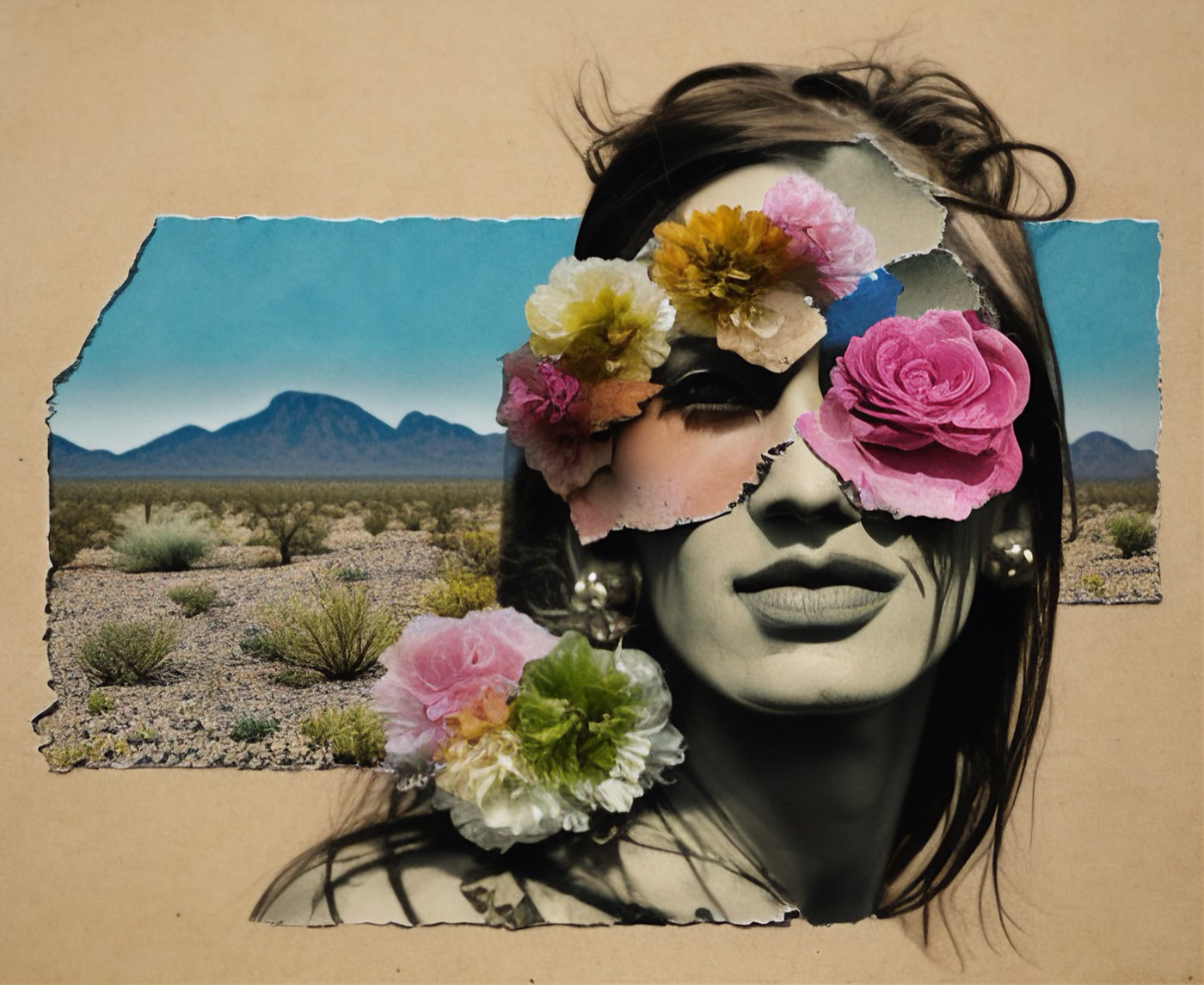
KaliYuga combines image-making with publicly shared tools for other artists. Code repositories and model experiments form an important part of the context for The Spaces Between Words.
Magic in overlooked places
KaliYuga is an artist and model-maker whose public reputation in AI art rests as much on the tools she has shared as on the works she has released. Her GitHub profile gives a compact self-portrait: "Like dust, magic gathers in overlooked places | she/her | ✡️ | #Aiart since 2020 | Stability.ai Staff".1 Her Linktree adds another side: "STEM chick by day, art and crypto do-er by night. Early NFT-er, musical dabbler."2 KaliYuga publishes under the pseudonym, and this essay does not attempt to identify the person behind it. It uses "she", following her own profile.
The pseudonym names the last and darkest of the four ages in Hindu cosmology, the age of strife. Paired with a motto about magic gathering in neglected corners, it suggests an artist who looks for wonder in unpromising places, though she has not explained the name in any source found, and that reading is this essay's.
A library for others
KaliYuga's early public work was curatorial. Her personal page keeps a "Colab Library", updated in March 2022, of twelve notebooks that defined the first wave of open AI image-making: The Big Sleep, VQGAN and CLIP, CLIP-guided diffusion, StyleDreams, Pixray PixelDraw, ruDALL-E, Disco Diffusion and others, each with its authors credited and a short note on its strengths.3 She described Disco Diffusion there as her daily driver.3 The page also lists press: a March 2022 Boing Boing item on Midjourney and Vox's June 2022 video "The AI that creates any picture you want".3
A library like this is a small act of public service. In 2021 and early 2022, the best tools for AI art lived in scattered Colab notebooks, each with its own settings and its own Discord lore. Collecting them, crediting their makers and explaining which to use for what lowered the barrier for artists who were not programmers. The library is careful about terms as well as features. It flags a ruDALL-E fine-tuner as "For non-commercial use only", notes which methods are slow or resource-hungry, and adds a standalone keyframe generator by another developer for finer control of Disco Diffusion's animation.3 That attention to credit and licence returns in her own models, which spell out exactly how others may use them.4
Pixel Art Diffusion
KaliYuga then moved from collecting tools to building them. Her announcement of Pixel Art Diffusion called it "my first-ever publicly-released AI model": a "custom-trained unconditional diffusion model trained on an original (small) dataset of ~1500 256x256 pixel art landscapes", made "using the fine-tuning openai diffusion model notebook by Alex Spirin".5 "I will expand this dataset over time," she wrote, and she did. A later version of the model on Hugging Face, pixelartdiffusion4k, was "trained on ~4100 hand-picked pixel art pieces", released under a Creative Commons licence that leaves outputs free to use but asks tools built on the model to credit her.4
The repository records the work's growth through versions 1, 2 and 3, a version "With Disco Symmetry", and a companion Watercolor Diffusion notebook.6 It is the most popular of her public projects, with several hundred stars, and her pinned repositories add Watercolor, Lithography and Pulp Sci-Fi Diffusion, each a model tuned to reproduce a particular visual medium.1 A guide credited to her, "Training Your Own Unconditional Diffusion Model with Minimal Coding", carried the method to others.7 Its reach shows in passing: interviewed by the newsletter Stable Digest in April 2023, another AI artist recalled, "I would train my own model for DiscoDiffusion first, using KaliYuga's guide."8
Pixel art was a pointed first choice. It is a medium defined by hard constraints, a coarse grid and a limited palette, that the general image models of 2022 tended to blur. A model trained only on pixel art could hold those constraints, and the repository's successive versions record the effort to make it do so.6 That reading of why the medium mattered is this essay's; the announcement itself does not give a reason.5
The pattern is consistent. Each model takes a medium with a strong, recognisable look, pixel art, watercolour, lithograph, pulp illustration, and teaches a network to work inside it. The craft is in the dataset: choosing, cleaning and labelling the images that define the medium. "Hand-picked" is the key word in the model card.4
DreamBooth and captions
As image generation moved to Stable Diffusion, so did her tools. Her DreamBooth fork, built on Shivam Shrirao's implementation, adds automatic captioning with BLIP, adapted from victorchall's EveryDream tools, and an "Omnitool" that turns image filenames into per-image captions, so that a training set can be described image by image rather than with one broad prompt; its changelog runs to March 2023.9 The README credits ChatGPT for "copious help" in writing the Omnitool.9 Her pinned repositories add a fork enabling Stable Diffusion 2 in DreamBooth and a notebook for BLIP, LoRA and DreamBooth fine-tuning.1 By then she was listed as Stability AI staff.1
The Spaces Between Words
KaliYuga's BrainDrops release came in June 2023. The Spaces Between Words, project 23, was released on 14 June as an edition of 500 collage portraits. The release calls it "a mono-mixed-media/post-collage series that delves into the inner landscape of human experience", which, "exploring the unspoken depths of memory, emotion, and identity", reveals "intricate topography within the gaps and nuances of our inner lives".10
Each image looks like a physical collage photographed on a table: torn paper, cut photographs, newsprint, embroidery and flowers arranged around a face. The first token minted, Decked Out, crowns a fractured black-and-white face with flowers in raised satin stitch; Daisy Duet, the last, sets a face in colour beneath a torn newsprint brim, the print close to legible without being readable, text present as texture rather than language.11,12 What Light Leaves Behind, the first public mint, wraps a face in cut-out flowers and a patchwork of coloured papers.13 The series essay reads the three in detail.
"Mono-mixed-media" is the release's own phrase, and her model-making history suggests a reading: a single generated surface imitating many materials, one medium pretending to be several. That is the same skill her public models practise, teaching a network the look of a medium. No source states how this edition was made, and no notebook for it is among her repositories, so the connection is offered as interpretation.
The sale opened at 17:00:11 UTC with a holder phase, the first token minted through the ArtistProxy's mintForGenesisDropHoldersOnly function by a collector naming one token each from the three first-day collections.14,15 Holder minting ran to the 144th token at 17:28:47 UTC; the public sale began at 17:29:35, and the 500th token was minted at 17:44:47 UTC, a sell-out on the day.16,17,18
Assessment
KaliYuga's place in the BrainDrops catalogue is that of a toolmaker who also makes art. Her public contribution, from the notebook library to Pixel Art Diffusion and the captioning tools, made model-training more accessible to artists, and others have said so.3,5,8 Her edition, a set of collages that seem handmade but are not, turns the same expertise in medium and surface towards an inner subject: the unspoken, the space between words.10
Gaps in the record
No interview about The Spaces Between Words was found, and its tools are undocumented. The date of the Pixel Art Diffusion announcement is not shown on the copy consulted.5
References
- KaliYuga, GitHub profile. ↩
- KaliYuga, Linktree. ↩
- KaliYuga, personal page and Colab Library. ↩
- KaliYuga, pixelartdiffusion4k model card, Hugging Face. ↩
- KaliYuga, "Model Release Announcement: Pixel Art Diffusion Colab Notebook by KaliYuga is now LIVE!", Hive. ↩
- KaliYuga, Pixel Art Diffusion repository. ↩
- KaliYuga, "Training Your Own Unconditional Diffusion Model with Minimal Coding: A Step-by-Step Guide", Artvy. ↩
- Stable Digest #5, interview with makeitrad, 20 April 2023. ↩
- KaliYuga, DreamBooth With Dataset Captioning repository. ↩
- BrainDrops, "The Spaces Between Words", official project record. ↩
- BrainDrops, token record, Decked Out. ↩
- BrainDrops, token record, Daisy Duet. ↩
- BrainDrops, token record, What Light Leaves Behind. ↩
- Mint transaction for token 23000006, mintForGenesisDropHoldersOnly. ↩
- BrainDrops ArtistProxy contract (0x5EC4…2Ccc), verified source. ↩
- Mint transaction for token 23000149, last holder-phase mint. ↩
- Mint transaction for token 23000150, first public mint. ↩
- Mint transaction for token 23000005. ↩
Researched and written with Claude (Anthropic); version not recorded in the repository in Claude Code · human review pending · research cutoff 2026-10-30 · token usage: per-essay usage unavailable from session telemetry · Original prose CC0 1.0.
BrainDrops releases
The Spaces Between Words
KaliYuga
Collectors and attribution
51 sampled wallets held a credited solo or collaboration release at block 26202469. Counts below cover only those releases, excluding the shared survey. Chain audit data.
Each series biography links to the full sampled holder list. A wallet holding the collective project All AI Art Looks The Same is not automatically counted as holding work by every participant. Token-level artist attributes are needed to make that more specific claim.
Artist names here are public release credits. Aliases and collaborations are resolved only where the credited record supports the relationship.