
huemin
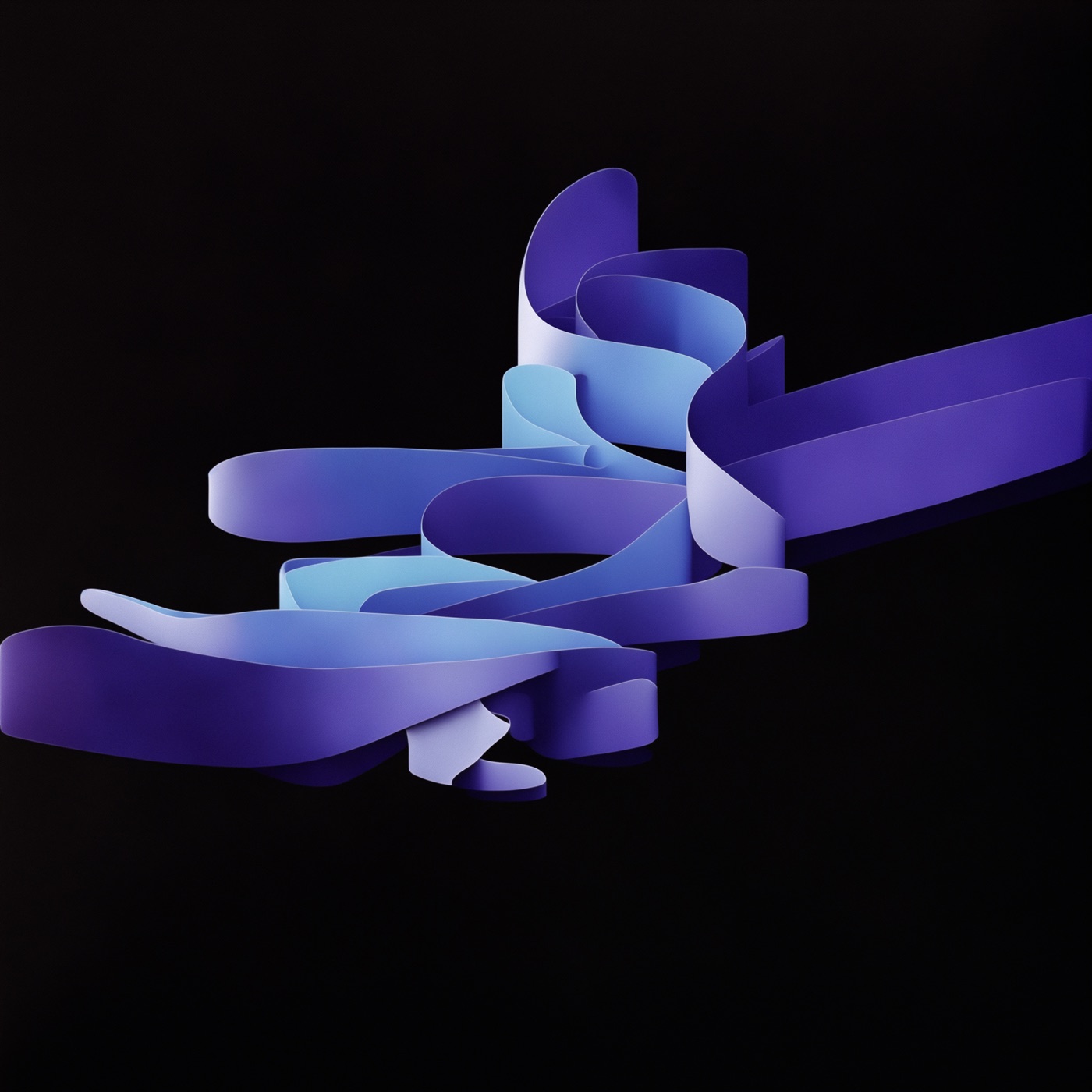
huemin is an artist and developer whose self-description connects engineering and physics with AI and creative computing. The artist identifies as the creator of Deforum and maintains an open-source practice alongside artworks. Materia Mania concentrates that experimentation on diffusion’s unstable forms, making the model’s artefacts the centre of attention.
Artist and toolmaker
huemin is an artist and developer whose practice runs on two tracks at once: making AI artworks, and building the open-source tools that many other AI artists use. The artist's site puts it in three lines: "AI artist and developer since 2021. Background in engineering and physics." "Creator of Deforum. Founder of Deforum Studio and Dream Computing." "A16Z open source AI grant recipient."1 Raster describes "a generative AI artist and programmer who explores the relationship between humans, artificial intelligence and digital space", whose work blends "vibrant color" with "minimalist aesthetics and geometric abstraction, from vector-style architecture to post-impressionist digital paintings".2 The artist publishes under the pseudonym, and this essay does not attempt to identify the person behind it. No pronoun statement was found, so the essay uses the name or "the artist".
Deforum
The tool came first in public reach. Deforum emerged in 2022 as a community project for animating Stable Diffusion, the open image model released that year. Its public model page describes it in four words, "Animating prompts with stable diffusion", and credits "a community of AI image synthesis developers, enthusiasts, and artists".3 The method turns a sequence of text prompts into video: each frame is generated from the one before, with camera moves in two or three dimensions applied between frames, so that a scene can zoom, pan and transform as the prompts change. By November 2022 an extension had brought it into the most widely used Stable Diffusion interface; the Japanese tech site Gigazine described it then as a tool "which can generate animations using images generated by Stable Diffusion as frames", set by prompts keyed to frame numbers.4 The main repository, created in October 2022, records more than two thousand stars.5
Le Random calls Deforum "a free-to-use stable diffusion inference tool", and also credits huemin with JAX Automated Stitching, another open-source contribution.6 In a March 2024 episode of MoCA Live, huemin was introduced as "an original StableDiffusion contributor", in a conversation about how AI models work, how the field developed, and how to keep open-source developers supported, along with the risks if they are not.7 On this essay's reading, much of the drifting, morphing video associated with early diffusion animation in 2022 and 2023 was made with Deforum or tools like it. That influence is hard to measure, and it means huemin's work reaches far beyond the artist's own editions.
Materia Mania
huemin's BrainDrops release turned the same engineering habits to a still image. Materia Mania, project 17, was released on 12 March 2023 as an edition of 1,000.8 The official description is short: "a collection of abstract, AI generated forms set against a solid black background", whose goal was "to highlight the emergent and chaotic nature of diffusion models by reinforcing their tendency to create artifacting shapes and textures".8
That reverses the usual aim of image generation. Most work with diffusion models tries to suppress artefacts, the smears and impossible surfaces that betray the machine. Materia Mania sets out to amplify them until they become the subject.
The artist's project page documents the method in unusual detail. "Materia Mania was created using an iterative process involving generative coding, aesthetics modeling, and AI augmentation." The base images were simple combinations of geometric shapes and colours on a plain background, made by code. Then "A custom generative-art diffusion model was fine-tuned on 120K image-text pairs to produce high-fidelity abstract augmentations of these base images." In all, "25K base images were initially generated and incrementally upscaled to a resolution of 4096x4096", and an aesthetic rating model helped select the final thousand.9
The method is a hybrid of two generative traditions. The base layer is classic generative art, shapes and colours defined in code; the surface is diffusion, which takes those plain forms and gives them invented materials, lacquer, rubber, folded card, that belong to no real substance. The selection step is itself automated in part, a model trained to judge aesthetics standing between twenty-five thousand candidates and the final edition. The tokens record shape, colour and texture as traits, with values such as arc, flat and ribbon for shape, and latent, matte and trace for texture.10,11 A texture called latent names the space inside the model where such surfaces come from, a small sign that the edition is as much about the system as about the forms it made. The uniform black ground and soft overhead light hold the presentation constant, so that the variation a viewer sees is the variation the model introduced. The Materia Mania series essay reads three of the forms.
The sale followed the pattern of early 2023. The first token, #430, was minted at 17:00:59 UTC; about 470 tokens were minted in the first half hour, consistent with the early window for holders of BrainDrops' first collections that a contemporary survey described; and the remainder went in seconds, the final token, #429, at 17:30:47 UTC.12,13,14,15 BD5D holds token #315, minted in the same closing block.16
Installations and exhibitions
Since Materia Mania, huemin's work has moved into physical spaces. Raster records The Dream Cathedral, made with the artist Ganbrood for the 2024 Venice Biennale period, a site-specific interactive AI installation presented by Bright Moments at the Chiesa di San Giovanni Evangelista.2 The artist's site lists events from Beyond Basel in 2022 through Bright Moments Tokyo, Seoul Blockchain Week, MUTEK Mexico and Bright Moments Buenos Aires in 2023, to Venice, Paris, Tokyo, London and Miami Art Basel in 2024.1 An Art Blocks collection, Source, was made for Bright Moments, and a series, New Dimension, appeared with Mirage Gallery.1
Both the artist's site and Raster also list inclusion in Christie's sale of February 2025, which matches Augmented Intelligence, the house's first auction devoted to AI art, held online from 20 February to 5 March 2025.1,2,17 Christie's sale overview does not name huemin among its featured artists, so this essay takes the inclusion from the artist's own record.17
Raster also notes a collaboration that shows the toolmaker's side again: a custom diffusion model, built with the artist No Usr and trained on the work of the painter Jenni Pasanen.2 Building a model for another artist's practice is a natural extension of a career spent building tools for a community.
Assessment
huemin's place in AI art is unusual because it is double. As an artist, huemin made in Materia Mania one of the most clearly documented BrainDrops releases, a hybrid of coded geometry and a fine-tuned diffusion model, aimed explicitly at the model's own characteristic artefacts.9,8 As a developer, huemin led a tool that shaped what diffusion animation looked like for a period, and gave it away.6,3 The two tracks share a disposition: an engineer's interest in what a system does when pushed, and a willingness to make that behaviour the point.
Gaps in the record
No long-form interview with huemin was found in text; the MoCA Live conversation is audio, and only its description was used. Le Random's biography dates the practice to 2001, which conflicts with "since 2021" on the artist's own site and on Raster; this essay follows the artist's site.1,2,6 This biography cites seventeen sources, one short of the AB5D floor of eighteen.
References
- huemin, artist site. ↩
- Raster, artist profile, huemin. ↩
- Deforum, "deforum_stable_diffusion", Replicate model page. ↩
- Gigazine, "Image generation AI 'Stable Diffusion' AUTOMATIC 1111 version extension 'Deforum'", 2 November 2022. ↩
- ecosyste.ms, repository record, deforum-art/deforum-stable-diffusion. ↩
- Le Random, artist profile, huemin. ↩
- MoCA Live, "A History of StableDiffusion, and Feeding the Open-Source World with Huemin", 28 March 2024. ↩
- BrainDrops, "Materia Mania", official project record. ↩
- huemin, "Materia Mania", project page. ↩
- BrainDrops, token record, Materia Mania 0431 (token 17000430). ↩
- BrainDrops, token record, Materia Mania 0316 (token 17000315). ↩
- Mint transaction for token 17000430, the first Materia Mania token. ↩
- Mint transaction for token 17000900. ↩
- Mint transaction for token 17000429, the last Materia Mania token. ↩
- Mr. Fox, "Why BrainDrops is the Art Blocks of AI art", The Metaversalist, 3 March 2023. ↩
- Token history, Materia Mania token 17000315. ↩
- Christie's, "Augmented Intelligence", online sale overview, 20 February to 5 March 2025. ↩
Researched and written with Claude (Anthropic); version not recorded in the repository in Claude Code · human review pending · research cutoff 2026-10-30 · token usage: per-essay usage unavailable from session telemetry · Original prose CC0 1.0.
BrainDrops releases
Materia Mania
huemin
Collectors and attribution
63 sampled wallets held a credited solo or collaboration release at block 26202469. Counts below cover only those releases, excluding the shared survey. Chain audit data.
Each series biography links to the full sampled holder list. A wallet holding the collective project All AI Art Looks The Same is not automatically counted as holding work by every participant. Token-level artist attributes are needed to make that more specific claim.
Artist names here are public release credits. Aliases and collaborations are resolved only where the credited record supports the relationship.