
Chikai
Chikai’s practice spans artworks and films. The artist’s site documents exhibitions and screen-based presentations as well as collections. Anthrocinematica uses the loop and a nested photographic view to make a personal, multicultural perspective into a structure that viewers can repeatedly enter.
From Google Earth to cinematic AI
Chikai Ohazama, who works as Chikai, is a Japanese-American artist and filmmaker whose first career was in building one of the most widely used pictures of the planet. The artist's biography introduces "the co-creator of Google Earth", who "holds a Ph.D. in Biomedical Engineering", and describes a practice of "cinematic AI".1 The sources used here do not include a pronoun statement in the artist's own words, so this essay uses the name or "the artist".
The earlier career is well documented. Raised in Tallahassee, Florida, Chikai graduated from Vanderbilt University in 1994 and earned a PhD in biomedical engineering from Duke University in 1998.2 A 2011 report on a return visit to Vanderbilt described the co-founder of Keyhole, the start-up that became Google Earth, who went on at Google to launch Earth, then Moon, then Mars.3 nft now's 2023 profile tells the same story: "co-creating a company named Keyhole, which would later be acquired by Google and become Google Earth".4 The artist now lives and works in San Francisco.2
Collector first
Chikai came to AI art as a collector. "I came in just out of curiosity and started collecting," the artist told OpenSea in 2025.5 The biography records MONOLITH Gallery, a digital space founded to house the artist's collection and curatorial projects.1 Making followed: Chikai "started experimenting with Midjourney and other tools, just trying to grasp the medium", and looked back at GANs and the history of the field.5 On a 2024 Verse broadcast with Roope Rainisto, in which Chikai took part, the artist reflected on that double position: "I've been lucky enough to be accepted by both sides of the aisle."6
Cinematic AI
Chikai's term for the practice is "cinematic AI", a sub-genre of AI video that the biography says the artist has written about, "crafting deeply layered narratives with generative AI models and workflows".1 The medium suits an artist who had long wanted to make films. "AI video just gave me a medium to express that in a way I hadn't found before," Chikai told OpenSea, and "You don't need a big budget or a full crew to make a film."5 The process is exploratory: "I'll start with something really simple," with the aim of chasing a feeling rather than a fixed image.5 In the essay Cinematic AI, Chikai defines the approach through image-to-video models and identifies Runway Gen-2 as a breakthrough. Camera controls and motion brushes matter in this account because they give the artist ways to shape movement within a generated scene. Chikai describes the arrival of Luma Dream Machine in June 2024 as a further transformation of the practice, after Anthrocinematica had been released.7
The first collection under that name, Cinematic AI, was discussed by nft now in October 2023. Chikai described the starting question, "I was thinking about how bodies of work are formed", and the theme, a "reflection on humanity and its relationship to nature and to itself".4 The short film Saving Nine opened the inaugural Napa Valley Asian American Film Festival, and the work has been shown in Norway, London, Rome, Dubai, Miami and New York.1
Anthrocinematica
Chikai's BrainDrops release, Anthrocinematica, project 32, was released on 29 March 2024 as "an AI video collection composed of 500 perfect loop sequences".8 "Each sequence zooms in on a single photo from a wall of photos in one of thirteen rooms, where each room is located in different countries (Ethiopia, Finland, India, US, Japan)." Each room has "two dimensions, one where the wall of photos are of people and places in Japan and the other is of people and places in the US", forming "an imperfect yet idealistic microcosm of human life both on a global scale, but also a personal one as the duality of each room reflects the multi-cultural heritage of the artist".8
The release description and Chikai's Cinematic AI essay explain the work's visual structure and wider context, but neither specifies the models or software used to produce Anthrocinematica.8,7 The title joins anthropology and cinema, and the release explains both: a survey of rooms across five countries, and a single camera move that turns each still archive into a shot. The doubling is personal. Every room hangs either a Japanese or an American family album, and "Leaning into the nature of AI, these concepts are also blended together in unusual and subtle ways, which helps to show how the world is not black and white, but it is a blend of many different elements to form what makes us all human."8
There is a quiet continuity with the earlier career. Google Earth zooms from orbit to a street; Anthrocinematica zooms from a room to a face in a photograph. Both are about scale and the pleasure of closing in, though the artist has not drawn the comparison, and it is this essay's reading.
The theme of a doubled heritage runs through the choice of material. A wall of photographs is how families, shops and community centres display memory, and the pictures on it are usually the most personal images people own. Anthrocinematica fills five hundred such walls with photographs of no one, and lets a Finnish kitchen or an Ethiopian living room hold either a Japanese or an American album.
The tokens show the structure at work. Lost in a crowd, held by BD5D, opens on a photograph of a young woman in a crowded square and pulls back through a pinboard of street photographs to a white-tiled Finnish kitchen covered in small prints.9,10 Consideration, the first token minted, finds a grey-haired man's portrait repeated across a peeling plaster wall in an Ethiopian living room, a recurrence that reads as memory.11 Hubris, the last, zooms into the same room from another photograph, showing the fixed set and the many possible shots within it.12 The series essay reads the three loops.
The sale was slow. The first token, #35, was minted at 16:30:59 UTC through the ArtistProxy's holder function; the public sale opened at about 17:01 UTC; and minting then ran for almost two weeks, with another run of mints that first evening.13,14,15,16,17 The edition was completed on 11 April 2024, when the artist's address reserved the last tokens one at a time to individual recipients, the 500th, #34, at 17:36:11 UTC.18,19 Some recipients had minted earlier in the sale, so the reserve served to finish distribution rather than to keep tokens back. Like Metalands and UBK before it, the edition records how thin demand had become for BrainDrops releases by 2024, and how artists and the platform chose to complete editions anyway.
Anomalia and after
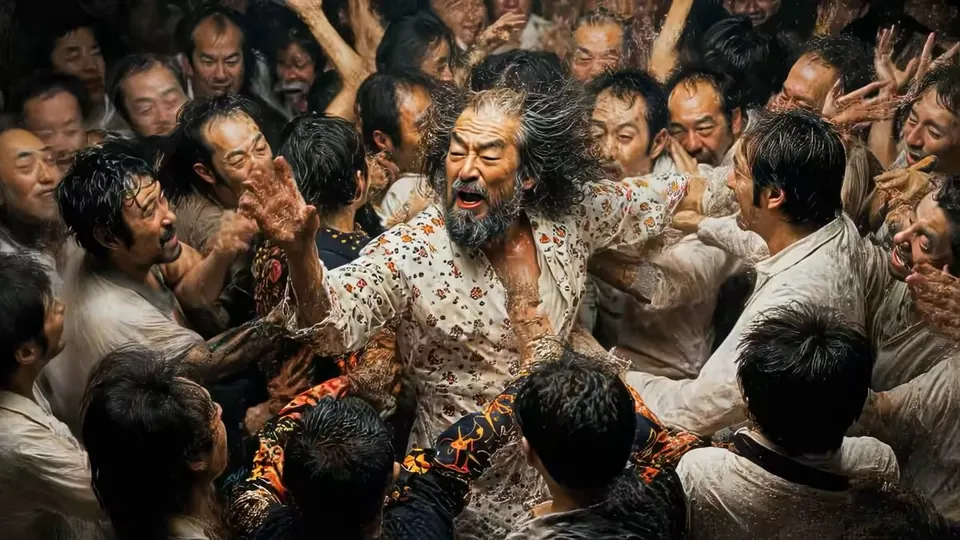
The later work extends cinematic AI into stills and video together. Anomalia, shown at Vertu Fine Art in July 2025, presents dense crowds that seem to be attacking, fleeing or surviving, from whose bodies fish-like forms emerge; "While the images offer an impression, the videos offer a story," the gallery wrote.2 Chikai described a related project to OpenSea: "It's a combination of physical still prints and a digital video collection."5 Anomalia was a finalist for the 2025 Lumen Prize in the still image category.1
Assessment
Chikai brings to AI art an engineer's career in images of the whole world and a filmmaker's ambition held back until the tools allowed it.1,5,3 Anthrocinematica is the clearest statement in the BrainDrops catalogue of the cinematic AI idea: a fixed set, a camera move and a story implied by a single photograph, built on the artist's own doubled heritage.8 It treats generated images as a family album that belongs to everyone and no one, which is a fitting subject for a collection made from the visual memory of a machine.
References
- Chikai Ohazama, "About". ↩
- Vertu Fine Art, "Works from Anomalia by Chikai Ohazama at VFA", 16 July 2025. ↩
- Venture Nashville, "Google exec who launched Earth, Moon & Mars returns to Vanderbilt School of Engineering", 22 February 2011. ↩
- Arthur Parkhouse, "Inside Chikai Ohazama's 'Cinematic AI': A Reflection on Humanity", nft now, 25 October 2023. ↩
- OpenSea, "In Conversation with Chikai Ohazama", 22 July 2025. ↩
- Verse, "Chikai and Roope Rainisto on LIWA, Reworld and Vacation", 8 May 2024. ↩
- Chikai Ohazama, "Cinematic AI". ↩
- BrainDrops, "Anthrocinematica", official project record. ↩
- BrainDrops, token record, Lost in a crowd. ↩
- Token history, Anthrocinematica 32000076, mint to transfer into the BD5D wallet. ↩
- BrainDrops, token record, Consideration. ↩
- BrainDrops, token record, Hubris. ↩
- Mint transaction for token 32000035, mintForGenesisDropHoldersOnly. ↩
- BrainDrops ArtistProxy contract (0xa104…Ce07), verified source. ↩
- Mint transaction for token 32000085, public mint. ↩
- Token history, Anthrocinematica 32000285. ↩
- Token history, Anthrocinematica 32000435. ↩
- Token history, Anthrocinematica 32000020, reserved. ↩
- Reserve transaction for token 32000034 by chikai.eth. ↩
Researched and written with Claude (Anthropic); version not recorded in the repository in Claude Code · human review pending · research cutoff 2026-10-30 · token usage: per-essay usage unavailable from session telemetry · Original prose CC0 1.0.
BrainDrops releases
Anthrocinematica
Chikai
Collectors and attribution
30 sampled wallets held a credited solo or collaboration release at block 26202469. Counts below cover only those releases, excluding the shared survey. Chain audit data.
Each series biography links to the full sampled holder list. A wallet holding the collective project All AI Art Looks The Same is not automatically counted as holding work by every participant. Token-level artist attributes are needed to make that more specific claim.
Artist names here are public release credits. Aliases and collaborations are resolved only where the credited record supports the relationship.