
Artemis
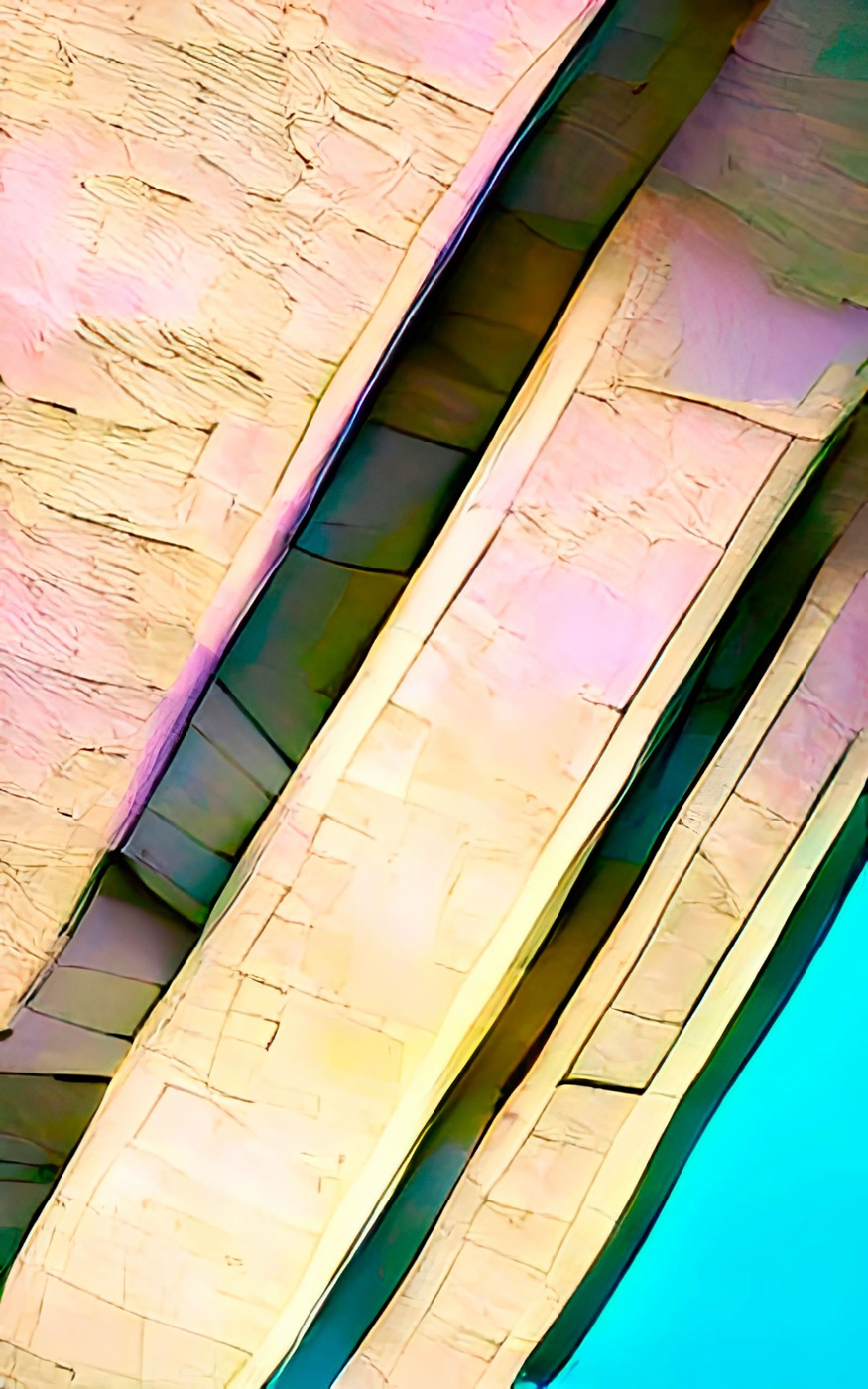
Artemis connects software, cryptography and generative imagery with the physical act of painting. The practice extends from digital editions to custom plotters and layered works on paper.
Code, simulation, pigments
Artemis is a pseudonymous generative artist who works with code, trained models and physical media. The name is styled in lower case on some platforms, and the artist's handle elsewhere is artemisandarts. The artist's own site gives the practice in three words, "Code, simulation, pigments", and lists three bodies of work: the CONFINE series, "Generative oil painting on archival paper, 2025"; standalone one-of-one works; and SELF 32, "400 digital self-portraits".1 Raster's artist page describes "a generative artist working at the intersection of code, machine learning and physical process", whose early works trained neural networks to turn spoken or written language into images, and who later extended the approach to plotter drawings and generative oil paintings.2
This essay does not attempt to identify the person behind the name. A December 2023 episode of the podcast Proof of Art described Artemis as "a generative artist who creates his own algorithms and trains AI models using his own datasets", and the 2024 Tribul interview also uses "he"; this essay uses the name and "the artist", as no statement of pronouns by the artist was found.3,4
Models trained on one's own drawings
The defining feature of the early work is the dataset. Proof of Art stressed that Artemis "trains AI models using his own datasets", and the earliest work traced here shows what that meant.3 ARTMS SELF, released on Foundation in 2021, is described on Raster in the artist's words: "ARTMS is an algorithm based on the model trained on own hand drawings for the creation of my original self-portraits."5 The same listing describes the portraits as produced from "a hashed combination of inputs" given to that model, so that each output is fixed by its parameters rather than chosen by hand.5
The approach places Artemis among the artists who used AI as a way of extending their own hand rather than drawing on the internet's images. A model trained on one person's drawings can only recombine that person's marks, so its outputs remain self-portraits in a double sense: pictures of the artist, made from the artist's drawings. The later SELF 32 series of 400 digital self-portraits continues the subject.1,2
The podcast's topic list fills in more of the practice: an early interest in digital art, the origin of the name, series called Haiku Minions and Dining Dante, generating outputs with a consensus algorithm, and making generative work that resembles traditional art.3 Those works were not located for this essay, so they are named only. The episode also reports that Artemis had released work with BrainDrops and Mirage Gallery, and that the art had been shown at Art Miami.3
SIGHTS on BrainDrops
Artemis's BrainDrops release, SIGHTS, project 10, was launched on 2 March 2022. The release text is two sentences: "SIGHTS is a collection of 500 unique artworks. A generated visual tour of a machine uncovering a diverse universe of shapes and colors."6 Raster dates the work to 2022 and repeats the description.7 Each token is a tall image of planes, curves and edges in a few flat colours, closer to a photograph of modernist architecture than to the dreamlike scenes of the releases before it.
The metadata reads like a designer's specification. Tokens record a background colour, a cycle, a colour count, one or two shape families such as Blocks, Lanes and Arcs, and a density, and in the tokens examined for the SIGHTS series essay the images match their traits closely: an Arcs token shows arcs, a one-colour token is nearly monochrome.6 That suggests the traits were inputs to the generator rather than labels applied afterwards, consistent with the artist's habit of building custom systems, though the release does not document the model.
SIGHTS also departs from the earlier self-portraits. Where ARTMS SELF looked inward, SIGHTS describes "a machine uncovering a diverse universe of shapes and colors", an impersonal tour of surfaces.6 The common thread is control: in both, the artist defines the inputs and lets a trained system generate within them. In March 2023 Artemis was among the fourteen artists of All AI Art Looks The Same.8
From screen to paper
The more recent work has moved into the physical. In a May 2024 interview with Tribul, the artist described a series of plotter works: "Abstract portraits generated by a simple algorithm."4 "Core to my process is often calculated automation using randomness," Artemis said, and "Using a plotter is one way that allows me to carry my automated processes from digital into physical."4 The artist described being "stimulated and curious about borrowing randomness and spontaneity from the natural world", and enjoying "the technical challenge of creating outputs with a natural and organic presence".4 On colour and line: "My aim in using these colors, in combination with a low count of strokes, is to convey depth from simplicity."4
The CONFINE series of 2025, generative oil paintings on archival paper, takes that path further.1,2 It is a long way from the screen-based images of SIGHTS, but the logic is continuous: an automated process, partly random, set up by the artist and carried into a medium where material behaviour adds its own variation. "Code, simulation, pigments" describes the sequence.1
The artist presents the community around the work simply. "It's just about friendships," Artemis told Tribul, and "Meeting people that find my work to be resonating with them is a great pleasure and honour."4 SuperRare lists the artist's works there under the description "Generative artworks".9
Gaps in the record
The public record is thin, and this biography falls short of the AB5D standard's floor of eighteen substantive sources; it cites nine. The artist's own project page for SIGHTS could not be read, the Mirage Gallery release was not identified, and the Haiku Minions and Dining Dante series were not located. No source documents the model or training data for SIGHTS.
References
- Artemis, artist website. ↩
- Raster, artist page, Artemis. ↩
- Proof of Art, "Artemis: Customizing AI Models & Generative Algorithms", recorded 1 December 2023. ↩
- Alexia Wright, "Inflection: an interview with artemis", Tribul, 7 May 2024. ↩
- Raster, "ARTMS SELF by artemis", 2021. ↩
- BrainDrops, "SIGHTS", official project record. ↩
- Raster, "SIGHTS by artemis", 2022. ↩
- BrainDrops, "All AI Art Looks The Same", official project record. ↩
- SuperRare, artemisandarts profile. ↩
Researched and written with Claude (Anthropic); version not recorded in the repository in Claude Code · human review pending · research cutoff 2026-10-30 · token usage: per-essay usage unavailable from session telemetry · Original prose CC0 1.0.
BrainDrops releases
SIGHTS
Artemis
All AI Art Looks The Same
Various Artists
Collectors and attribution
60 sampled wallets held a credited solo or collaboration release at block 26202469. Counts below cover only those releases, excluding the shared survey. Chain audit data.
Each series biography links to the full sampled holder list. A wallet holding the collective project All AI Art Looks The Same is not automatically counted as holding work by every participant. Token-level artist attributes are needed to make that more specific claim.
Artist names here are public release credits. Aliases and collaborations are resolved only where the credited record supports the relationship.