
Wubbushi
Wubbushi, also known as Jon Washburn, uses AI to make images that borrow photography’s authority while unsettling what it can prove. His work moves between spiritual rupture, digital alienation and invented memory. The Rapture, his BrainDrops series, asks what happens to human purpose when artificial intelligence destabilises the identities on which it rests.
Also credited as Jon Washburn · Jon Wubbushi.
From technology to pictures
Wubbushi, who signs some work as Jon Wubbushi, is an American artist who makes what the artist calls "photographs no camera took". The artist's own site sums up the practice in one line: "I make pictures by hand and by machine: paintings, photographs no camera took, and art that lives on Ethereum."1 An interview summary on Expanded.Art says the artist was "Born in Yakima, Washington, and raised in Seattle", and "transitioned from a serial tech entrepreneur to a dedicated AI artist".2 The artist began making art in 2022, according to a 2026 essay on HOLY, and has also built an open-source AI image platform, MANIFESTED.3 The artist's site and statements are written in the first person, and the sources used here record no pronouns stated by the artist, so this essay uses the name or "the artist".1
The way in was DALL-E 2. In a Collector's Corner episode recorded before The Rapture's release in October 2024, the artist discussed discovering it and starting an art career, what drew them to AI creation, and the patience and systematising the work demanded.4 The Verse biography describes "a meticulous approach to generative AI image making" that "combines the raw immediacy of street photography with the expressive power of figurative and abstract painting", and roots it in the artist's "own experiences with generational dissociation".5 Expanded.Art places the work in "a new visual language native to AI-based Post Photography", naming Murakami, Koons, Warhol, Baldessari and Duchamp among its influences.2
A mirror and a subconscious
The artist has described the early work as an inquiry into the machine itself. "Early works like Trash Babies and Trans were attempts to see through the lens of AI," Wubbushi told AI Collection. "At first, it felt like AI was simply a mirror of humanity, reflecting our cultural data back at us."6 Then the frame changed: "I realized something more personal: these images were also reflecting parts of my own subconscious."6
That shift runs through a sequence of series. The artist's site describes The Crisis as "Humanity's disconnection from the spiritual" and Modern Zombies as "Humanity's disconnection from each other".1 The Crisis, 150 works issued through Manifold in 2024, opens its statement with six words, "Fractured. Replicated. Disjointed. Replaced. Lost. Broken.", and claims "a new approach in the evolution of spiritual iconography in art history".7 The Collector's Corner conversation traced the stylistic change from The Crisis to Modern Zombies.4 Looking back in 2026, the artist summarised the trilogy that ended with The Rapture as "broken spirituality, lost human connection, lost human identity".3
Past Forward
Past Forward, fifty works released on Verse on 23 April 2024 and presented by Heft, took the photographic illusion into history.8 Its statement calls the series post-photographic historical fiction about the cycles of humanity's darkest moments in the twentieth century: poverty, war, disaster and persecution. Each piece shows a moment that never happened but could have, intended to prompt reflection and empathy, and the text argues that no single image can hold the whole truth of a trauma.8 The release coincided with Verse's exhibition MORE.zip.8 The idea that a fabricated photograph can carry a real history returns, more personally, in HOLY.
Method at scale
The method is volume followed by selection. The Collector's Corner notes list a discussion of generating thousands of outputs for each chosen piece and the techniques the artist uses for novel results, as well as the incorporation of illustrative elements.4 The same show's newsletter reported that the artist generated "500,000 images" to arrive at the 300 in The Rapture.9 The artist also described what they saw as "The Golden Era of post photography AI", and why it might be slipping away.4 No source names the specific models used for the BrainDrops release.10
The Rapture
The Rapture, project 36 on BrainDrops, was released on 14 October 2024: 300 works at 0.05 ETH.10 Releasing on BrainDrops had been a long-held goal, the artist told Collector's Corner.4 The release describes "a future where AI's rise leads humanity into a vortex of existential absurdity and fragmented realities".10 The artist's account is more inward: "Rapture takes the existential disconnection explored in my earlier collections" and "documents this direct confrontation."6 "AI doesn't create this crisis," the artist said; "it exposes the fragility of our identities."6 The question the artist poses is internal: "how do we evolve when the very foundation of what defines us is in flux?"6 The project site sets lines between the images: "Rage against becoming nothing" and "If the future does not need you, where do you exist?"11
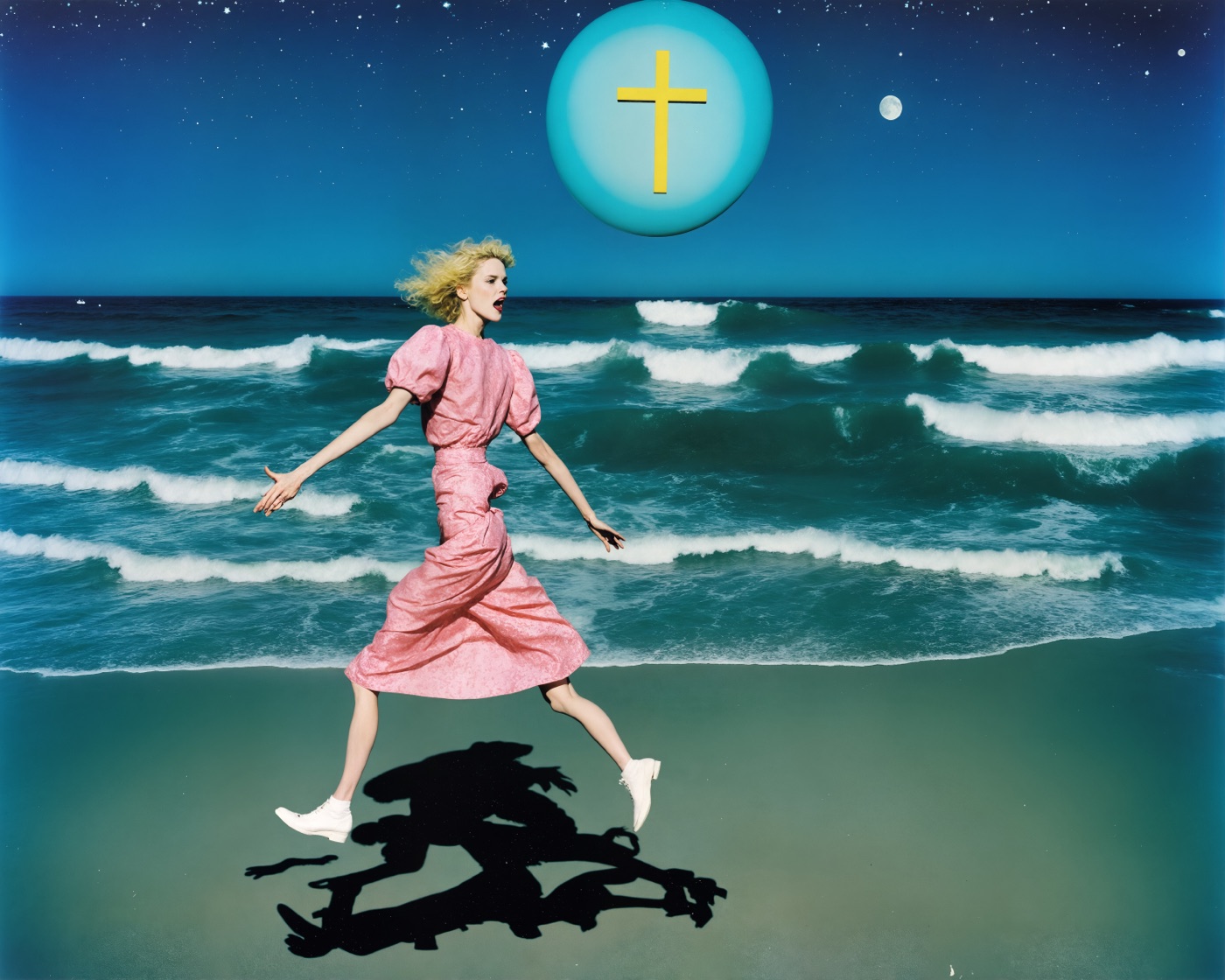
The images look like colour photographs from an earlier decade, with grain, flash and light leaks, into which impossible events intrude. "Throughout The Rapture, whimsical elements sit side by side with something more unsettling," the artist said.6 In Shadow, held by BD5D, a woman runs along a night beach under a turquoise sphere bearing a cross, and her shadow is a many-limbed shape that is not hers.12,13 Intrinsic_Value, the first token minted, launches dozens of cheerleaders into the air above a crowded stadium.14 Interstellar, the last, shows translucent figures dissolving into a field of stars.15 The series essay reads the three images in full.
The sale opened with a public mint at 17:00:23 UTC; the 102nd token, Shadow, followed at 17:03:47, the 201st at 17:07:23, and the 300th at 17:10:11 UTC, nine minutes and 48 seconds after the first.16,13,17,18
HOLY and after
After The Rapture the work turned to memory. HOLY, 500 works released on Verse on 25 August 2026, reconstructs an evangelical adolescence with AI images, simulated film stocks and an invented darkroom process, because the family photo albums were lost.3 The artist calls it "my lost adolescence, an evangelical coming of age that was never simple enough to hate."3 The essay on the release puts the paradox plainly: "The archive is counterfeit. The need for it is not."3 The artist's site also lists Debits, All One, a series of 100 canvases, and All Dogs, an invited painting project, showing a practice that has moved off the screen as well as on.1
Assessment
Wubbushi's subject has been consistent: what images of people mean once a machine can make them. The early series asked what AI reflects; The Rapture asked what people are for when it outperforms them; Past Forward and HOLY asked what a fabricated photograph can still remember.6,8,3 "AI has taught me that the images I create often ask questions I don't yet have the words for," the artist said. "It's not about arriving at answers".6
Gaps in the record
The tools used for The Rapture are not documented, and the Expanded.Art interview and the Collector's Corner episode were used only through their published summaries. The HOLY essay is published on the site of BD5D's owner, so it is not independent.3,2,4
References
- Wubbushi, official site. ↩
- Expanded.Art, "Wubbushi: Leftoverism", interview with Anika Meier. ↩
- maxand98, "HOLY: Wubbushi's Imagined Remembered Adolescence", 25 August 2026. ↩
- Collector's Corner, "The Rapture by Jon Wubbushi", Release Reveals 3, 10 October 2024. ↩
- Verse, "Jon Wubbushi", artist page. ↩
- AI Collection, interview with Wubbushi on The Rapture, rapture.wtf. ↩
- Raster, "The Crisis by Jon Wubbushi". ↩
- Verse, "Past Forward by Wubbushi", series page, presented by Heft, 23 April 2024. ↩
- Collector's Corner, "Cornering The Market #85", 11 October 2024. ↩
- BrainDrops, "The Rapture", official project record. ↩
- Wubbushi, The Rapture, project site. ↩
- BrainDrops, token record, Shadow. ↩
- Token history, The Rapture 36000086, mint to transfer into the BD5D wallet. ↩
- BrainDrops, token record, Intrinsic_Value. ↩
- BrainDrops, token record, Interstellar. ↩
- Mint transaction for token 36000285, public mint. ↩
- Token history, The Rapture 36000185. ↩
- Mint transaction for token 36000284. ↩
Researched and written with Claude (Anthropic); version not recorded in the repository in Claude Code · human review pending · research cutoff 2026-10-30 · token usage: per-essay usage unavailable from session telemetry · Original prose CC0 1.0.
BrainDrops releases
The Rapture
Wubbushi
Collectors and attribution
15 sampled wallets held a credited solo or collaboration release at block 26202469. Counts below cover only those releases, excluding the shared survey. Chain audit data.
Each series biography links to the full sampled holder list. A wallet holding the collective project All AI Art Looks The Same is not automatically counted as holding work by every participant. Token-level artist attributes are needed to make that more specific claim.
Artist names here are public release credits. Aliases and collaborations are resolved only where the credited record supports the relationship.