
Fernando Jerez
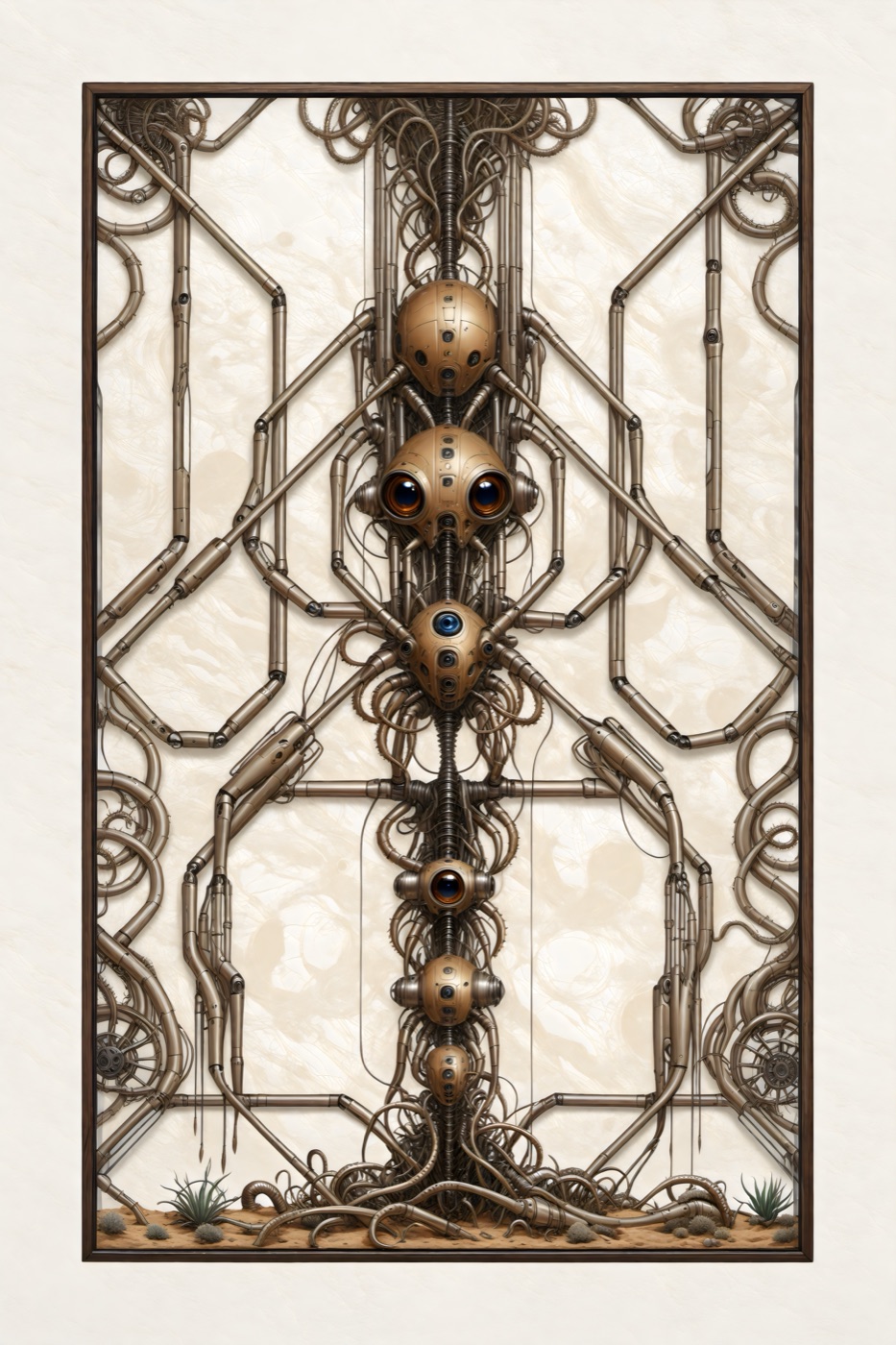
Jerez describes himself as a computer-science engineer and teacher with a practice rooted in coding and creative technology. His account traces an early interest in BASIC and procedural graphics to Stations, his February 2022 Art Blocks release. UBK extends the world of UMK with AI-generated context, making his work a particularly direct connection between the AB5D and BD5D archives.
A teacher who draws with code
Fernando Jerez is a generative artist and computer science teacher whose work comes out of long-form code rather than out of AI. The artist's site puts the practice in one line: "Algorithmic, generative, creative coding… whatever you call it, I draw with code."1 The Art Blocks profile is just as plain: "Hi! I'm Fernando Jerez, a computer science teacher and passionate about generative art," who likes drawing with algorithms.2 No pronoun statement was found in the artist's own words, so this essay uses the name or "the artist".
The background is that of a programmer who came back to graphics. "I graduated from university as a software engineer and worked a few years in web development," Jerez writes; "In 2009 I started working as a teacher."3 The interest goes back further: "in the late 80's i was a kid with an Amstrad CPC464 computer learning Basic language".3 After experiments with Flash, OpenGL and DirectX, the turning point came in 2010: "Discovered Processing IDE in 2010 which revived my passion for computer graphics and algorithmic art."3 Processing is also the language Jerez uses to teach structured and object-oriented programming.3
From bots and printers to blockchains
The site's timeline records a decade of side projects before the art market arrived. From 2016 Jerez designed for 3D printing, publishing many designs, several of them procedurally generated, on Printables, Thingiverse and Cults. In 2017 came a Twitter bot that ran Processing sketches and posted the images. In 2020 the work moved to p5.js and JavaScript, since "Java is no longer available in browsers", and in January 2021 Jerez won a game jam with KosmikRun: "It was an intense one-week project that finally won the Jam."3
Read together, these projects show procedural generation as a habit across every medium to hand: printable objects, a bot that publishes its own sketches, a game built in a week. The common element is a set of rules that produces variety, which is also the premise of long-form generative art, where collectors mint outputs that the artist has never seen. The teacher's habit shows too: Jerez explains the method of each project in plain terms, and the site's timeline reads like a syllabus of the tools tried and left behind.3
The move to blockchain generative art came in 2022. Stations, released on Art Blocks in early 2022, is a set of 900 procedurally generated science-fiction structures.3,4 Its description builds a world: "Nine factions populate the virtual space. While Utopians develop the main net, the others work on their nodes building an economy system over the secondary chains." The project, it adds, "plays with procedural architectonic structures".5 Art Blocks featured the collection in its Behind the Code series in December 2022, in an episode in Spanish.6
Other collections followed on Art Blocks and fxhash, including Metropixeland, Mandalomatic and Neonphobia.3 Neonphobia, of 2022, is "the second collection of 'DEFRAG Trilogy' or 'How the machine took over our lives'", a trilogy that asks viewers "to think about what your life would be like without all the technology that surrounds us". It "represents the moment when you're fooled by technology and you think you're in control, but it was an illusion. You're serving the machine."7 Roots, released on Art Blocks in 2024, swings the other way, towards the archaic: "Roots is raw, unrefined, rough, fresh. Fat pixels, naked textures, rude compositions."8
The projects share a sensibility: built worlds, machines with societies or moods, and an interest in how far an algorithm can go in suggesting a story.
UMK and the mechanical life form
The direct source of Jerez's BrainDrops release is UMK, an Art Blocks Presents project. Its description begins: "Imagine a world where technology not only advances mechanically, but also adapts and changes in response to its environment."2 Its other key line is a metaphor: "The UMK algorithm could be thought of as a life form that has evolved from a seed."2 UMK, short for Ultra Mechanika, is an algorithm that grows machinery: pipes, gears, joints and housings, drawn in fine line. The artist's project page dates its release on Art Blocks to 1 May 2023 and gives it 762 pieces, "built over almost a year of iterations and improvements", and presents it as "an extension of the Defrag Trilogy, where I talk about the relation that we have with the machines".9
UBK: Ultrabionika
UBK: Ultrabionika, project 27 on BrainDrops, was released on 27 October 2023 as an edition of 500.10 Its release asks: "What unfolds when a technologically evolving life form interweaves with distinct facets of its environment?" It explains the link plainly: "UBK (UltraBionika) expands on the narrative exploration initiated in its predecessor, UMK. With a strong symbiotic relationship, UBK builds upon UMK pieces, infusing them with AI-driven context."10 The result is "a rich and surprising collection of outputs that maintain coherence and diversity, all stemming from the foundation of a long-form generative process".10
The method is a hybrid unusual in the BrainDrops catalogue. Long-form code supplies the structure; an AI stage supplies the environment. The artist's page states that "Each output is built over an UMK piece" and lists the tools as ComfyUI with the WAS suite and a model named MBBXL Ultimate V.0.1.9 A 2023 post, "Matching Gen Art X A.I.", sets out the reasoning: generative code is good at consistency, diversity and rarity, while AI adds narrative and context, and UBK should feel like a continuation of UMK "that has been partially evolved".11 Each token records a Bionika trait naming the setting, alongside Evolution, Coloring, Symmetry and Density, the last two reading like parameters of the underlying algorithm.12,13,14 The first token minted, Wasps And Bees, shows a lattice of grey pipes on which yellow-and-black insect machines cling, one stacked like a hive; Shallow Reef, the last token sold, fringes its pipework with coral fronds and bubbles; Antarctica, the last token minted, is a symmetrical totem of eyed pods wrapped in cable, with icicles hanging from the pipes.12,14,13 In each, a restricted palette and a few environmental cues are enough to turn the machine into a creature in a habitat. The series essay reads the three images.
Ultra Mechanika becomes Ultra Bionika: the machine learns from biology. The idea runs back through the earlier work, from the factions of Stations to Neonphobia's machine that takes over our lives. In UBK the machine adapts to its surroundings rather than dominating them.5,7,10
A hard sale
The release also documents the weak market of late 2023. The first token, #146, was minted at 16:59:59 UTC by a holder of BrainDrops' first-day collections, and the public sale was open by 17:29:47 UTC.15,16 But the edition did not sell out. The 228th and last token sold, #373, was minted on 12 November 2023.17 On 24 December 2023 the remaining 272 tokens were minted through the ArtistProxy's reserve function in two transactions from the artist's address, 136 to braindrops.eth and 136 to the artist.18,19,20 The official count of 500 of 500 therefore includes more than half the edition unsold, split between platform and artist.
Assessment
Jerez is a coder first, and UBK is best read as a generative artist's experiment with AI, not an AI artist's experiment with code. The structures are UMK's; the AI adds habitat, texture and implied life.10 That makes UBK one of the clearest cases in the BrainDrops catalogue of the two traditions meeting in a single image, and a continuation of a long practice of building small, rule-driven worlds, from Amstrad BASIC through Processing to the blockchain.3
Gaps in the record
Which UMK outputs were used for UBK, and how they were paired with tokens, is not documented. The artist's site dates Stations to February 2022, while Verse records its release on 26 January 2022; this essay says early 2022.3,4 The Behind the Code episode is video and was cited from its listing only.6
References
- Fernando Jerez, artist site. ↩
- Art Blocks, "UMK" by Fernando Jerez, Art Blocks Presents project page. ↩
- Fernando Jerez, "About". ↩
- Verse, "Stations by Fernando Jerez". ↩
- Raster, "Stations" by Fernando Jerez. ↩
- Art Blocks, "Behind the Code: Stations by Fernando Jerez (En Español)", 6 December 2022. ↩
- Raster, "Neonphobia" by Fernando Jerez. ↩
- Raster, "Roots" by Fernando Jerez. ↩
- Fernando Jerez, "U·B·K Ultrabionika", project page. ↩
- BrainDrops, "UBK: Ultrabionika", official project record. ↩
- Fernando Jerez, "Matching Gen Art X A.I.", 2023. ↩
- BrainDrops, token record, UBK #146 Wasps And Bees. ↩
- BrainDrops, token record, UBK #145 Antarctica. ↩
- BrainDrops, token record, UBK #373 Shallow Reef. ↩
- Mint transaction for token 27000146, mintForGenesisDropHoldersOnly. ↩
- Mint transaction for token 27000180, public mint. ↩
- Token history, UBK 27000373, last token sold. ↩
- Reserve transaction for tokens 27000374 to 27000009, to braindrops.eth. ↩
- Reserve transaction for tokens 27000010 to 27000145, to fernandojerez.eth. ↩
- BrainDrops ArtistProxy contract (0xa104…Ce07), verified source. ↩
Researched and written with Claude (Anthropic); version not recorded in the repository in Claude Code · human review pending · research cutoff 2026-10-30 · token usage: per-essay usage unavailable from session telemetry · Original prose CC0 1.0.
BrainDrops releases
UBK: Ultrabionika
Fernando Jerez
Collectors and attribution
43 sampled wallets held a credited solo or collaboration release at block 26202469. Counts below cover only those releases, excluding the shared survey. Chain audit data.
Each series biography links to the full sampled holder list. A wallet holding the collective project All AI Art Looks The Same is not automatically counted as holding work by every participant. Token-level artist attributes are needed to make that more specific claim.
Artist names here are public release credits. Aliases and collaborations are resolved only where the credited record supports the relationship.