
Devi Parikh
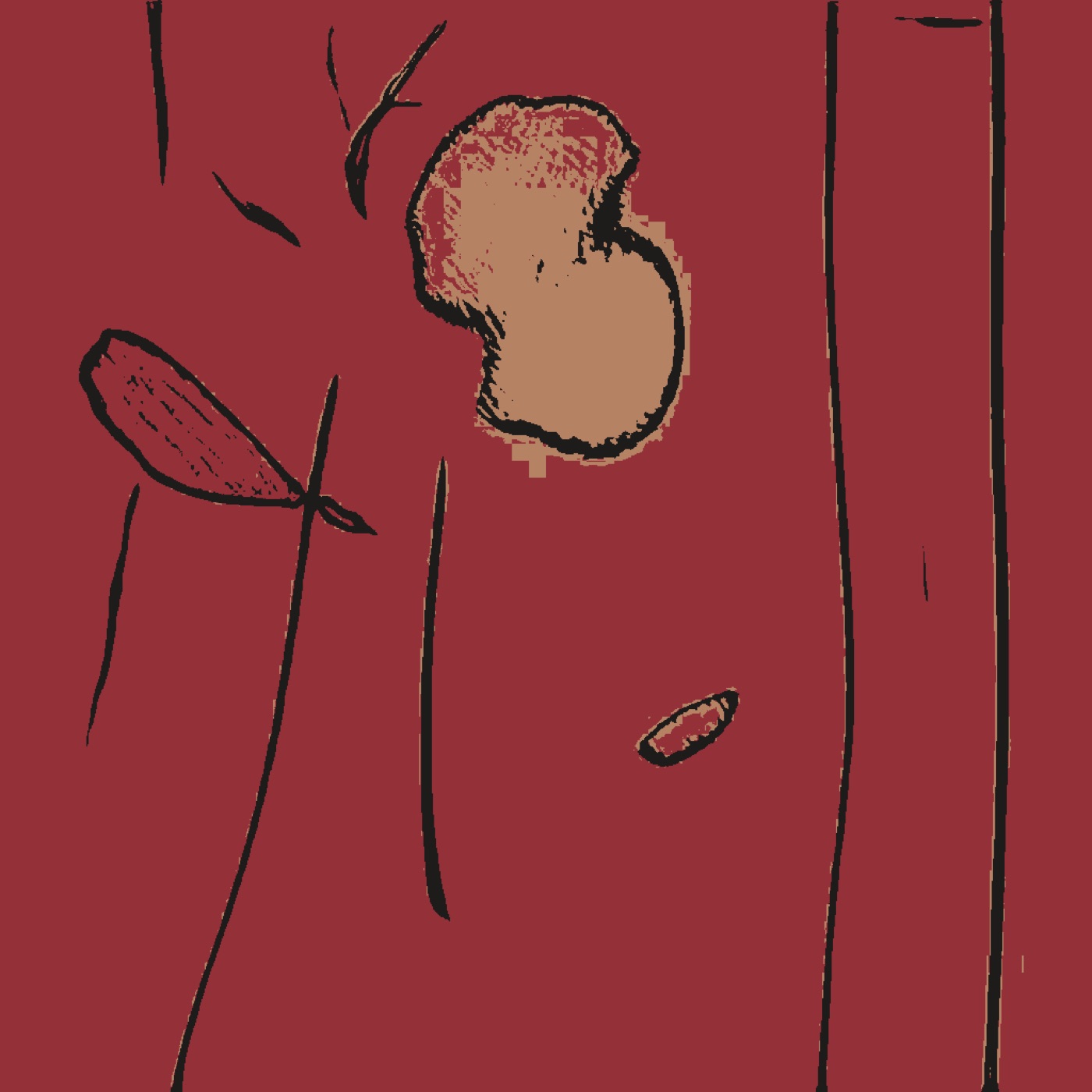
Parikh’s practice joins research into human preferences with image-making. Her 2020 paper studies what interactions with generative art can reveal about a creator’s preferences. Confluence offers a different, material encounter with authorship: her own sketchbook supplies training material, and colour choices and machine interpretations extend the original marks.
A researcher of vision and language
Devi Parikh is a computer scientist and generative artist whose research helped shape how machines connect images and words. Her own site introduces her as "AI Researcher, Generative Artist", and gives a career of unusual breadth.1 She received her master's and doctoral degrees from Carnegie Mellon University in 2007 and 2009. "From 2009 to 2012, she was a Research Assistant Professor at TTIC", the Toyota Technological Institute at Chicago, and then "an Assistant Professor at Virginia Tech for three years", before joining "the School of Interactive Computing at Georgia Tech in 2016".2 Georgia Tech listed her as an associate professor whose research covered "Generative Models, AI for Creativity, Computer Vision, Natural Language Processing", and as a research director at Meta's Fundamental AI Research lab.3 "Till March of 2024, Devi was a Senior Director in Generative AI at Meta and an Associate Professor at Georgia Tech," the biography continues; she then co-founded Yutori, where she is co-CEO.2 Yutori describes its products as "AI agents that autonomously browse and act on the web".4
Her research record is long. With colleagues, she proposed in 2015 "the task of free-form and open-ended Visual Question Answering (VQA)", a benchmark for systems that answer questions about images, which became a standard in the field.5 In 2022 she was a co-author of Make-A-Video, a Meta system for "directly translating the tremendous recent progress in Text-to-Image (T2I) generation" to video.6 Her biography lists an IJCAI Computers and Thought Award, a Sloan Research Fellowship, an NSF CAREER award and a Marr Best Paper Prize at ICCV, among many others.2 Her own site uses "she" for her, and this essay does the same.
AI for creativity
Alongside the mainstream research, Parikh made creativity itself a research subject. In a 2020 episode of the TWIML AI Podcast, recorded after her talk at a computer vision workshop on fashion, art and design, she discussed how AI "could impact the creative process for artists, and help humans become more creative", including a tool that predicts a creator's preferences and a practice of visual journaling.7 The Gradient Podcast introduced her in 2021 as a researcher whose work spans "computer vision, natural language processing, embodied AI, human-AI collaboration, and AI for creativity", and linked papers on generating dance for a song, crowd co-creation of sketches and neuro-symbolic generative art.8
Several of these papers grew directly out of her own practice. In "Predicting a Creator's Preferences in, and from, Interactive Generative Art" (2020), she studied how an artist's choices in an interactive generative system could be learned.9 In "Neuro-Symbolic Generative Art: A Preliminary Study", with Gunjan Aggarwal, she proposed "a new hybrid genre: neuro-symbolic generative art", in which a neural network is trained on the outputs of a rule-based generative system, and reported that study participants found both the results and the process more creative than the rule-based approach alone.10 Creative Sketch Generation (ICLR 2021) introduced DoodlerGAN, a part-based model for drawing new creatures and birds, and reported that in one study "subjects prefer sketches generated by DoodlerGAN over those drawn by humans!"11
An artist's catalogue
Parikh's art section shows the scale of the practice. It lists analogue work, including fibre, sketchbooks and origami; digital work, including tessellations, symmetries and rangoli; and dozens of generative series, among them Genuary sets for 2021 and 2022, GANbook, Spractal, Streaks and Strokes.12 A "Create Your Own" section offers interactive versions of many of these, including Rangoli and Tessellation, and a crowdsourced gallery, so that visitors can make work with the same systems.12 The impulse is the same as in the research: to turn a creative process into something others can use and study.
Her long-form generative work on Art Blocks was made with Abhishek Das, a collaborator on "dozens of projects since 2015" who, by their account, "first introduced Devi to generative art in 2018".13 Cushions, an Art Blocks Factory edition of 200 that Art Blocks credits to Parikh and Das,14 is dated 2021 on Raster, where its description says it "brings together image processing and generative art techniques", and "Every single pixel and its connectedness to other pixels are explicitly considered".15 Aragnation, released on Art Blocks on 6 February 2023 as an edition of 128, is described on its project site as a "long-form AI generative art project" that deliberately uses two small, purpose-built models rather than a large neural network: a probabilistic graphical model that composes 25 prototype shapes in 17 colours, and a small network that maps coordinates to colour.16,13 The training data includes photographs taken by Das, and the title is "an anagram of 'No-GAN AI Art'".13 Both works treat AI as a component of a designed system rather than as a source of finished images.
Confluence on BrainDrops
Confluence, project 5, was released on BrainDrops on 5 January 2022: 1,000 images, sold at 0.1 ETH. The release opens: "This series is part AI, part human analog art, and part human digital art."17 Parikh's project page explains the pipeline. "Pieces are generated using a neural generative model (AI) trained on the artist's physical sketchbook", a GAN; the outputs are re-rendered with image processing and "re-colored in one of 39 hand-designed palettes"; and each piece is then "re-interpreted by an AI model" that may see one of 52 concepts in it.18 The trait that records this last step is called AI-Pareidolia, the name for seeing figures in random shapes, now attributed to a machine. Raster's listing reproduces the description.19
Confluence is the clearest statement of the practice. It starts in a paper sketchbook, the analogue work her catalogue records, passes through a GAN like those in her research, and ends with a machine's interpretation recorded as metadata.18,12 Every trait corresponds to a stated stage of the process. The Confluence series essay reconstructs the release and reads three of the images.
In March 2023 Parikh was one of fourteen artists in All AI Art Looks The Same, contributing a work titled Conflict, a 4,088 pixel square PNG.20
Research and art as one practice
Parikh's work does not divide neatly into science and art. The same questions run through both: how a human and a machine can make something together, how a system can learn what a person likes, and whether a machine's output can be judged creative. The research measures these things in human studies; the art sets them up as systems that collectors and visitors can use. Confluence and Aragnation, in particular, are designed so that the process is legible in the result, in traits and in published descriptions, which reflects a researcher's habit of documenting the method.
The scale of the systems is also a choice. Parikh worked on some of the largest generative models of her time, including Make-A-Video at Meta, yet her own art often uses small models trained on small, personal datasets: one sketchbook for Confluence, a set of hand-designed shapes for Aragnation.6,18,13 The Aragnation site makes the point directly by contrasting its purpose-built models with large neural networks.13 In the art, the interest is less in what a powerful model can produce than in how a modest one can extend a particular hand, a particular sketchbook, a particular set of rules. Neuro-symbolic generative art, the genre she proposed in 2020, names the same idea: a neural network learning from a system the artist designed.10
The move to Yutori in 2024 shifted her professional work towards AI agents, but her site continues to present her as both "AI Researcher" and "Generative Artist".1,2
Gaps in the record
No interview was found in which Parikh discusses Confluence or her art practice at length in her own words. The models used in Confluence are not stated on the pages consulted, and the art catalogue gives no dates for most series. Raster dates Cushions to 2021, while Art Blocks lists its release as 7 January 2022.15,14
References
- Devi Parikh, personal website. ↩
- Devi Parikh, "Bio". ↩
- Georgia Tech School of Interactive Computing, Devi Parikh. ↩
- Yutori, company website. ↩
- Aishwarya Agrawal, Jiasen Lu, Stanislaw Antol, Margaret Mitchell, C. Lawrence Zitnick, Dhruv Batra and Devi Parikh, "VQA: Visual Question Answering", arXiv, 2015. ↩
- Uriel Singer and others, including Devi Parikh, "Make-A-Video: Text-to-Video Generation without Text-Video Data", arXiv, 29 September 2022. ↩
- TWIML AI Podcast, "Human-AI Collaboration for Creativity with Devi Parikh", episode 399, 10 August 2020. ↩
- Andrey Kurenkov, "Devi Parikh on Generative Art & AI for Creativity", The Gradient Podcast, 1 October 2021. ↩
- Devi Parikh, "Predicting a Creator's Preferences in, and from, Interactive Generative Art", arXiv, 2020. ↩
- Gunjan Aggarwal and Devi Parikh, "Neuro-Symbolic Generative Art: A Preliminary Study", arXiv, 4 July 2020. ↩
- Songwei Ge, Vedanuj Goswami, C. Lawrence Zitnick and Devi Parikh, "Creative Sketch Generation", ICLR 2021. ↩
- Devi Parikh, "Art". ↩
- Devi Parikh and Abhishek Das, "Aragnation", project site. ↩
- Art Blocks, "Cushions by Devi Parikh", collection page. ↩
- Raster, "Cushions by Devi Parikh". ↩
- Art Blocks, "Aragnation by Devi Parikh and Abhishek Das", collection page. ↩
- BrainDrops, "Confluence", official project record. ↩
- Devi Parikh, "Confluence", project page. ↩
- Raster, "Confluence by Devi Parikh". ↩
- BrainDrops, "All AI Art Looks The Same", official project record. ↩
Researched and written with Claude (Anthropic); version not recorded in the repository in Claude Code · human review pending · research cutoff 2026-10-30 · token usage: per-essay usage unavailable from session telemetry · Original prose CC0 1.0.
BrainDrops releases
Confluence
Devi Parikh
All AI Art Looks The Same
Various Artists
Collectors and attribution
63 sampled wallets held a credited solo or collaboration release at block 26202469. Counts below cover only those releases, excluding the shared survey. Chain audit data.
Each series biography links to the full sampled holder list. A wallet holding the collective project All AI Art Looks The Same is not automatically counted as holding work by every participant. Token-level artist attributes are needed to make that more specific claim.
Artist names here are public release credits. Aliases and collaborations are resolved only where the credited record supports the relationship.