
Claire Silver
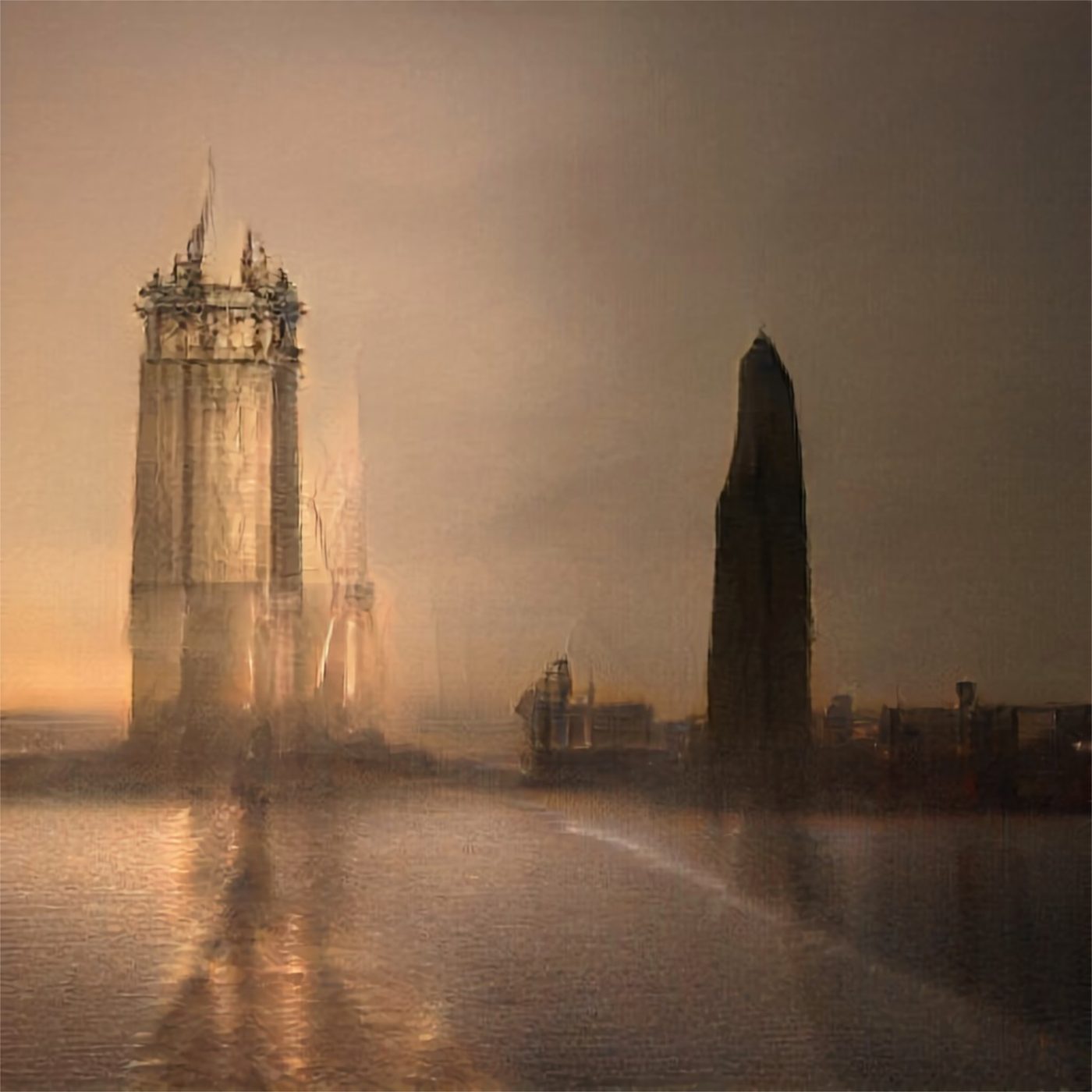
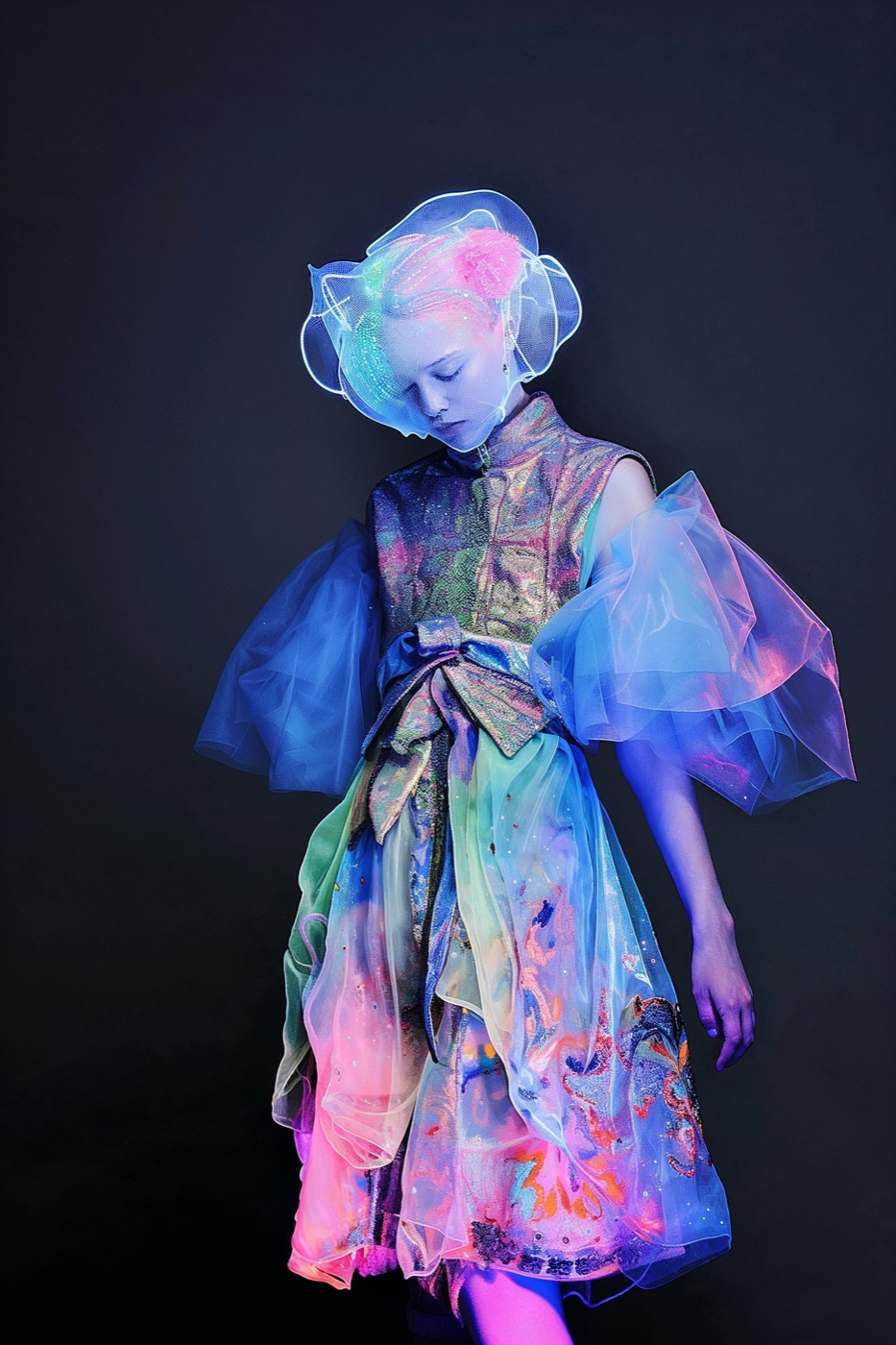
Silver describes AI as a collaborator in a practice that moves between analog and digital media. Her statement names oil, acrylic, collage and photography alongside digital tools, and connects the work to vulnerability, hierarchy and possible transhuman futures. The two solo BrainDrops releases move from a curated visual story to imagined fashion and embodiment; the collaborative release adds a third distinct context.
An anonymous collaborator
Claire Silver is a pseudonymous artist who works with artificial intelligence. Avant Arte calls Silver "an anonymous artist and leading pioneer in a rapidly developing era of AI-powered creativity", notes that "Claire Silver is a pseudonym", and dates the work with AI to 2017.1 Silver's own site states that the work "can be found in the permanent collection of the Los Angeles County Museum of Art", and that it "has been at Sotheby's London and Christie's New York".2 A speaker biography for Consensus 2024 describes "an anonymous AI-Collaborative artist that works with oil, acrylic, collage, photography", among other media.3 Silver's public face is a pink-haired avatar, which the Museum of Crypto Art called one of the most recognisable faces in crypto art.4
The anonymity is a principle, not only a precaution. In a 2024 episode of The TED AI Show, Silver described an online space where "No one could flex their background, their wealth, their family, their appearance, their job."5 The pseudonym puts the work forward and the biography back. This essay uses the name and "the artist" rather than pronouns, because the sources consulted do not record pronouns stated by Silver.
Illness and a new practice
Silver has tied the practice to a change in life. "One day I got sick," the artist told The TED AI Show. "I got hit with a life-changing chronic illness," and "Had to relearn how to walk, um, and talk."5 An NPR report in 2023 quoted the same account: the illness "ended that prior career".6 Speaking to the Museum of Crypto Art in late 2022, Silver said the illness had affected word recall and writing for some time, and that the image-making began "out of a need for expression, without judging myself on prior work".7
AI arrived in that context. "I became absolutely fascinated with the idea of a future that had solved for illnesses like mine," Silver said, and on first using an image model, "I made 30 or 40,000 images in a few days." The impression was immediate: "it was not just a tool, but it was a collaborator."5 The account of when this began varies slightly. Avant Arte gives 2017, while a Christie's lot essay calls blue girl (qualia), a GAN experiment of 2018, the artist's first AI creation.1,8
Qualia and curation
Silver's central idea has a name. "I have this concept of Qualia, which is the wordless experience of experiencing," the artist told the Museum of Crypto Art, adding that "most of my work includes some form of Qualia for me".7 The site describes the aim as transcendental work that evokes "a wordless truth", drawing on classical style and mythos and exploring vulnerability, trauma, disability, social hierarchy, innocence and divinity.2
The method is curation at scale. Silver told NPR that early on the process "was all curation", breeding AI images "like gardening plants or something".6 The Museum of Crypto Art interview describes "thousands and thousands of outputs" cut down to a few, often mixing models and sometimes starting from the artist's own drawings or public-domain paintings.7 A Museum of Crypto Art essay adds that Silver put old personal photographs into the datasets, so that the works contain literal pieces of the artist's own life.4 The Christie's essay for daughter, a 2025 portrait, describes a prompt first adapted from blue girl (qualia) in 2019 and rebuilt for each new model since, so that the same image has been carried through successive generations of AI.8 The same essay quotes the artist's hope that if AI one day "experiences qualia itself, we will know it is truly humanity's child".8
Silver is open about the tools. "It's just another very efficient, very collaborative, very cool tool," the artist said, and of training data, "It's not stealing, it's imagining."5 On the ethics of AI more broadly the site takes no side, and Silver has compared the artist to "a caveman painting fire".2 The more pointed claim is about skill. "With AI taste will become the new skill," Silver told TED, and the Consensus biography states the belief that with AI "the barrier of skill is swept away".5,3
Collections and controversy
Silver's early NFT work established the reputation. nft now reported that the genesis piece c l a i r e sold on SuperRare for 52 ETH, and named AI Art Is Not Art as the defining collection.9 The Museum of Crypto Art essay describes the first body of work as smudged and abstract, with undefined faces, and the second, including AI Art Is Not Art, as surreal.4
Institutional attention followed in 2023. The Art Newspaper reported that the gift of blockchain artworks to LACMA by the collector Cozomo de' Medici included "artificial intelligence (AI) art by Claire Silver".10 In March 2023 nft now reported that the talent agency WME had signed Silver as its "first AI artist", and that a new collection would debut at the Louvre. The report was later corrected: the venue was the Carrousel du Louvre, a shopping centre attached to the museum, and Silver withdrew from the Paris event, saying the announcement before the paperwork was final had been "a mistake".9 In 2025 daughter sold for $44,100 in Augmented Intelligence, Christie's first auction devoted to AI art.11,8
Silver has also used the platform to support other artists. Raster records that the sixth Claire Silver AI Contest, held for the artist's birthday in 2023 with the brief "How you see me", drew 1,400 entries in a two-week open call.12
BrainDrops
Silver's first release on BrainDrops, Genesis, was one of the three with which the platform opened on 15 November 2021: 500 images described as "raw AI images, created and arranged to tell a story".13 Silver later described it as "a narrative 500-piece story exploring building a new civilization on what came before", made with "no text, just visual cues".7 Its metadata gives each image a chapter, a cycle and a place, so that the story is told through traits rather than words. Flamingo DAO, an early collector, called it "a prime example" of the artist pushing past the limits of photography.14 The Genesis series essay covers the release in detail.
In March 2023 Silver was one of fourteen artists in All AI Art Looks The Same, contributing a work titled Genesis Echo.15 The second solo release, corpo | real, project 30, followed on 31 January 2024: 500 photographic images of bodies and clothing, introduced by a definition poem on the words "corpo" and "real", at 1 ETH, ten times the earlier price.16 Rarity Sniper reported that Silver described it as a year-long project done "with a great deal of rigor".17 The corpo | real series essay reconstructs that sale.
BrainDrops' founder Justin Trimble counted the first-day releases, Genesis among them, as some of the most seminal in the history of AI art.18 Read together, Silver's two BrainDrops editions trace the practice: from a wordless story told in painterly images to photographic bodies framed by a text about words.
Gaps in the record
The artist's identity is not public and is not sought here. The start date of the AI work differs between sources, 2017 or 2018. No source names the models used for Genesis or corpo | real. The Louvre episode is recorded from the contemporary report and its correction.
References
- Avant Arte, Claire Silver, artist page. ↩
- Claire Silver, "About". ↩
- Consensus 2024, speaker profile, Claire Silver. ↩
- Museum of Crypto Art, "And Helps us Do the Same (an Essay in III Parts)", 2023. ↩
- Bilawal Sidhu, "AI may take jobs, but not our creativity, with artist Claire Silver", The TED AI Show, transcript, 4 June 2024. ↩
- Scott Detrow, "With AI, artists reckon with the muddy questions of authorship", NPR, 2023. ↩
- Maxwell Cohen, "The concept of qualia: a sitdown with Claire Silver", Museum of Crypto Art, 4 January 2023. ↩
- Christie's, "Claire Silver, daughter", Augmented Intelligence, 2025. ↩
- Eric James Beyer, "Claire Silver's latest collection to premiere at the Louvre", nft now, 10 March 2023, updated. ↩
- Claire Voon, "Mysterious donor Cozomo de' Medici gives blockchain art to LACMA", The Art Newspaper, 13 February 2023. ↩
- Artnet News, "Christie's Augmented Intelligence AI auction results", 2025. ↩
- Raster, "Claire Silver AI Contest 6 by Niceaunties". ↩
- BrainDrops, "Genesis", official project record. ↩
- Hive Mind and Flamingo, "Expanding to New Forms: Recent Acquisitions from Flamingo DAO", 9 March 2023. ↩
- BrainDrops, "All AI Art Looks The Same", official project record. ↩
- BrainDrops, "corpo | real", official project record. ↩
- Rarity Sniper, report on the corpo | real sale. ↩
- Eric James Beyer, "BrainDrops founder Justin Trimble on the future of AI art", nft now, 27 April 2023. ↩
Researched and written with Claude (Anthropic); version not recorded in the repository in Claude Code · human review pending · research cutoff 2026-10-30 · token usage: per-essay usage unavailable from session telemetry · Original prose CC0 1.0.
BrainDrops releases
Genesis
Claire Silver
All AI Art Looks The Same
Various Artists
corpo | real
Claire Silver
Collectors and attribution
61 sampled wallets held a credited solo or collaboration release at block 26202469. Counts below cover only those releases, excluding the shared survey. Chain audit data.
Each series biography links to the full sampled holder list. A wallet holding the collective project All AI Art Looks The Same is not automatically counted as holding work by every participant. Token-level artist attributes are needed to make that more specific claim.
Artist names here are public release credits. Aliases and collaborations are resolved only where the credited record supports the relationship.